

Wholesale Demand Response Mechanism – 2025 AEMC Review – Final report findings and overview
This regulatory explainer provides an easy-to-understand overview of the AEMC’s 2025 review into the wholesale demand response mechanism (WDRM) and summarises the findings of the AEMC’s Final Report, published on 23 October 2025.
If you’re interested in our summary of the draft report, that is available here.
What is the WDRM?
Put simply, the WDRM is a way for electricity users to help balance the power grid by using less electricity when prices are high. The WDRM lets big users reduce their usage and get paid for it. The idea behind the WDRM is that demand response can help lower prices and keep the grid stable during peak times, which benefits everyone.
The WDRM is a relatively recent addition to the NEM and commenced operation on 24 October 2021. It enables companies (called demand response service providers) to offer demand response into the NEM, where it can be dispatched in the same way as generators.
The WDRM is currently the only market mechanism in the NEM wholesale market that facilitates demand response, that is, payment for reducing load. It allows entities other than the primary retailer to participate directly in the electricity market.
Why did the AEMC review the WDRM?
The AEMC is required to review the WDRM regularly under the
National Electricity Rules
What has the AEMC’s final report recommended?
Consistent with the draft report recommendations, the AEMC has made two key recommendations:
- The WDRM should continue operating.
- The Expanding Eligibility under the WDRM rule change request made by Enel X on 14 April 2022 be initiated.
Recommendation two means the AEMC will consider the merits of this rule change request and may allow sites that are served by multiple connection points to participate in the WDRM in the future. The AEMC notes this recommendation does not advocate for the proposed rule change, only that the request should be fully assessed. The AEMC anticipates initiating this rule change in the first half of 2026.
What are the benefits of the WDRM?
The AEMC acknowledges that if the WDRM were phased out, existing WDRM resources would be unlikely to participate in the NEM through alternative mechanisms.
The AEMC notes the WDRM has contributed to downward pressure on wholesale prices, with average price savings of $27.83/MWh during WDR dispatch. AEMC analysis estimates that between October 2021 and June 2025, the WDRM has resulted in $5.32 million ($1.42m per year) of dispatch efficiency benefits as well as additional emissions reduction benefits. This is higher than the estimated benefits in the draft report and shows the WDRM is providing efficiency benefits greater than its operational costs of $0.35m - $0.5m per year.
What are some other findings?
The AEMC reports that the recent Integrating price-responsive resources into the NEM (IPRR) and Unlocking CER benefits through flexible trading (CER benefits) final rules will help with strengthening demand-side participation in the NEM. These rule changes are both due to be fully implemented by mid-2027. The AEMC notes the CER benefits and IRPP rule changes are the key reforms to facilitating greater future demand-side participation in the NEM, not the WDRM.
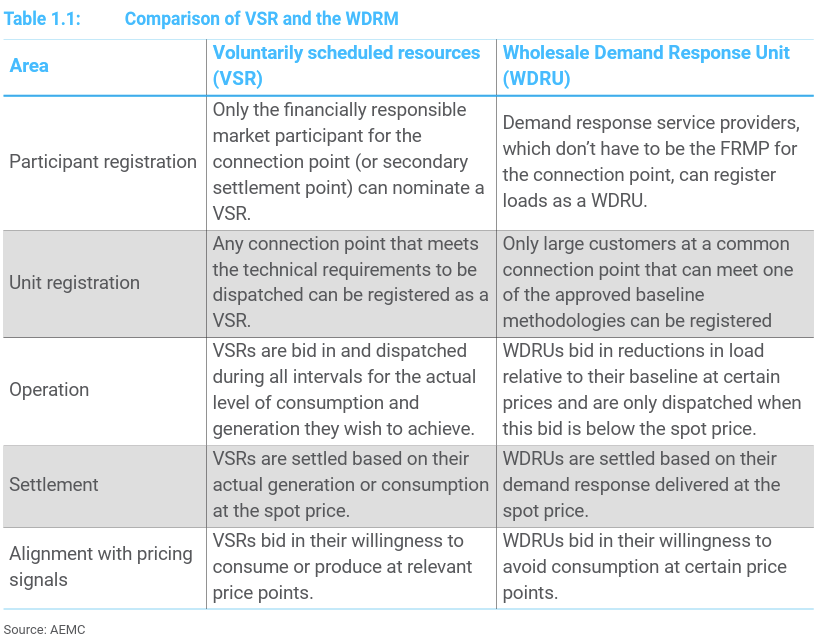
The AEMC explains the WDRM is providing a niche role for a subset of large loads in contributing to the total demand-side engagement in the NEM alongside the recently introduced demand-side mechanisms. As suggested by stakeholders, the AEMC has included a comparison table in the final report exploring the differences between voluntarily scheduled resources and Wholesale Demand Response Units as there are notable differences between the two mechanisms.
Is there unanimous support for the WDRM?
No, the AEMC noted that support for the WDRM is varied:
- Some stakeholders maintain the view that the IPRR is a better solution which justifies the phase out of the WDRM.
- In contrast, other stakeholders maintain the view the WDRM needs to be expanded to more participants, including potentially households.
The AEMC saw no reason to recommend phasing out the WDRM, recommending instead that the WDRM continue operating, and noted it has opportunities to grow. However, further work to facilitate small customers in the WDRM is not recommended by the AEMC at this time, until other reforms have progressed.
What are the interactions of this review with the National Electricity Market Wholesale Market settings review (NEM review)?
The NEM review has made some recommendations relevant for the WDRM as part of the broader theme of seeking increased visibility over resources (through requiring resources to be visible or dispatchable).
Specifically, as part of Recommendation 2:
- Large industrial and commercial loads with aggregated capacity of price-responsive load across their portfolio that exceeds the NER’s scheduled generation registration threshold (>30 MW), including those operating under price-contingent demand response contracts, should be required to provide load-intention data to AEMO via a dedicated visibility-only difference-bid mode or, alternatively, participate through the WDRM.
- Energy ministers should establish a structured support framework to encourage currently non-scheduled price-responsive resources (PRR) to participate in dispatch mode (active), the WDRM, or as scheduled loads, generators or bidirectional units.
If you’re interested in learning more, the NEM Wholesale Market Settings Review report is available here.
The AEMC’s final WDRM recommendations align with the NEM review and promotes resources being visible and dispatchable in the market.
Next steps:
The AEMC will seek to initiate the Expanding eligibility under the WDRM rule change in 2026.
The final report is available on the AEMC website: https://www.aemc.gov.au/market-reviews-advice/review-wholesale-demand-response-mechanism.